Showing posts with label applique border. Show all posts

Tuesday, February 9, 2021

Sewing Borders on the Shadow Star Quilt

Sisters are the perfect best friend.

Quilting


Unraveling on the edges of the completed borders drove me to attach the first three before finishing the fourth side. Here's the first side sewn.

First border sewn on Shadow Stars quilt top
First Vase and Vine border on Shadow Stars quilt

The next step was to sew the opposite side then to sew the third side, longer to accommodate the width of those border sides. An additional vine helps fill the space. 

Adding third Vase and Vine border
to Shadow Stars quilt

But there's a small problem. Someone stretched this side when creating the sketch. {I wonder who that could be?} It's not just that the seam allowances were forgotten. So... I'll be moving the final flower and perhaps a couple of leaves. 

A second flower unit is overlaid on the first to test moving of the applique
Testing adjustment of flower to fit side of quilt

With a petal from the fourth side, I tested the needed movement. This will take a couple of days. 


Reading

I finished several books in the past few weeks.

The Red Address Book by Sofia Lundberg relates the life of Doris Alm in flashbacks as she pages through her old address book. Born in Sweden, she became a maid in Madame Serafin's house upon the untimely death of her father. Madame took her to Paris where... Well, read the book for more. The vignettes are short; some characters repeat. Although her life spans 96 years the story only brushes world history.

Benjamin Franklin's 13 virtues have long interested me. Gretchen has the same interest bet she created her own set of virtues to guide her through a school year in Happier at Home. Like the quote from Ursula LeGuin's Left Hand of Darkness, Gretchen sees both sides of the coin can increase our happiness (or discontent.} So collecting and purging, staying home and going out, limiting time and taking all the time are all included in this book.

I'm much older than she but found some thoughtful ideas in her mix of "memoir, science, philosophy, and experimentation." 

My Bed by Salley Mavor is a permanent part of my collection of children's books. Salley illustrates her books with tiny, meticulous hand stitched 3D bas-reliefs of children sleeping around the world. As a maker I adore her work. As a grandmother I love the inclusion of world cultures to raise my grandchildren's awareness and appreciation of others.

Enjoy the day, Ann

Tuesday, January 26, 2021

Finally Adding Flowers

People overestimate what they can do in a single day and 
underestimate what they can do in their whole lives.
~unknown but possibly Bill Gates


Quilting


With the vines and leaves finally sewn, it's time to sew the flowers. There have been several iterations as you can see by the "cut and paste" of the template under this border. After recopying the entire swag once, I wore out and simply cut the old flower out and taped a new version in. Why? Because the petals extended too far and ended at the edges of the border fabric. 

The flower base that covers the vine end was simplified, too. It's now a unique three lobed shape without specific leaf structures.

One tulip version had three separate petals that were too difficult to deal with. And I don't think they used less fabric than this simple bowl. It's definitely easier to sew this one that fits over the base easily. Since hand-quilting is not planned, the extra thickness shouldn't matter.  

A lightbox is used to place tulip petals on the border.
Lining up the tulip petals

Then a teardrop petal was appliquéd on top. After looking at several placements, I matched the base of the teardrop with the base of the cup but the three petal points are lined up with the drawing underneath.

Basted tulip petal is pinned in place on an applique border
Pinning the final tulip petal

Here are two of the vines extending from the center vase. The quiet speckled green print was a gift from my friend, Gayle. Thank you. There wouldn't have been enough leaves without that addition. 

Two vines extend from a blue vase in this applique quilt border
Vine and leaf detail

And here's one side of the shorter border. Wow, that pink stands out. 

Two vines with pink tulips extend from a blue vase in this applique quilt border
Half of a vessel and vine border

Do you see the rabbit in the vase print? I'm still considering re-applying the base of the vase. That curve is off a smidge.

QS gifted me some owl fabric at Christmas. Ever since college, my sisters notice and send any and all owls they encounter. This heavier linen blend made a simple, useful tote.

Tote with brown owl print and yellow


Monthly FUR (Fabric Use Rate) 

A kawandi placemat and the tote were finished in January. We are in the middle of home repairs so sewing slowed significantly. YTD = 2 yards.

Electric Socket Shock QAL

The first post is next week. Are you ready? I can't wait to see what everyone does with this basic block.  

Did you see it? The Iowa Quilt Museum has a new exhibit, String Theory, about... {wait for it}... string quilts. How timely is that? Works from the ten quilters and collectors in the show include my friends Sujata Shah, Fern Royce, and Rod Kiracofe.  

Curator Linzee McCray defines string quilts as "thin lengths of fabric sewn onto a foundation." They are usually considered utilitarian as evidenced by the random foundation papers on the backs of unfinished tops. The technique lends itself to "happy accidents and intricately planned designs alike." 

The first Zoom meeting was last week and featured Rod with Siobahn Furguson discussing their quilts.  More meetings are planned on Tuesdays at noon CST. You can sign up on the museum's website. {I'd link it here but it's not https. Doggone it. So look up their name.} They also plan a gallery walk online for $6 - the regular admission price. I can't wait and only wish I could attend in person!

Enjoy the day, Ann

Tuesday, January 19, 2021

Never Ending Leaves and a Few Bud Bases

It is possible to read the history of this country as one long struggle to extend the liberties established in our Constitution to everyone in America.
~Molly Ivins

The US turns to healing our bodies and souls with the inauguration of President Joe Biden and Vice-President Kamala Harris tomorrow. I will be but early to watch. Let's commit to more than watching though. Let's become involved, especially in local matters and primaries, so horrors like these last few years don't happen again.

Both the 2016 and 2020 elections showed that the majority of Americans did not support the policies of the group that came to power in 2016. By neglecting to participate early, by waiting to see who and what "the parties" promoted, we lost the opportunity to shape those policies. A small group of dedicated, single-issue radicals swung our national agenda shamefully and cost us hundreds of thousands of lives.

Adults know we have to do things we don't want. Sometimes it's working every day, putting on a smile when we would rather go back to bed. Creating equitable political structures is another duty of adulthood - if for no other reason than to keep sadistic, misogynistic, and racist opinions out of the laws of our land.

Quilting


I cut out all the leaves starting with the smallest fabric remnants to maximize diversity. They were then sorted into four piles like dealing cards so each border has basically the same ratio of each fabric. Here is my set for the second side. Oh, my fingers hurt from all this sewing. Even with a thimble.

A stack of hand basted leaves with pincushion and thread spool
Basted leaves for a quilt border

Of course, the first two sides are shorter than the last two so I started sewing them first. Then the leftover leaves were set aside for the longer sides. It's not a perfect system but maintains some semblance of diversity.  

Again the leaves are blanket-stitched so their stems nestle under the vine. I shortened both the stitch length and the zigzag. My Bernina also has a mirror image function that lets me align the "teeth" of the blanket stitch to either side. That makes sewing easier, too. 

Bernina 1240 set to applique leaves with a blanket stitch
Blanket stitch by machine

Once the leaves are sewn, I re-pin the vines and sew them down. Then it's time to add the flower bases. This template has had the most changes. At first I planned a double-lobed leaf on each side, kind of like a dumbbell. It was too difficult to machine quilt and I ended by including the base with the leaves. Actually it now just looks like a larger base. Whatever. It works. 
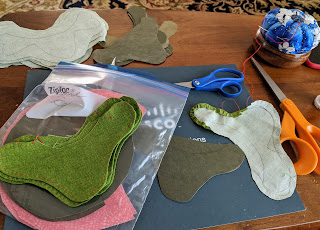
A stack of hand basted flower bases with scissors and pincushion
Basted flower bases for an applique quilt border

In the plastic bag the bright pink flowers are cut and ready to be basted next. It's taking about three days to get all the parts basted and another day to pin just the leaves. Then sewing, repinning, more basting. Not a lot to show at the end of the week but I'm sticking with it. It's time to get this top done. I only hope it looks as good as my sketches. 

Lectures

One of the unexpected joys of the pandemic is the upwelling of internet meetings that allow international speakers and audience to interact. And one of the benefits of multiple program chairs is the diversity of vision they provide. Sue Bianchi, one of our program chairs, arranged a unique speaker for our December guild meeting - Harriet Riddell of the UK spoke on Street Stitching Around the World. Artists must be brave to put their work out for public response but Harriet takes it to another level. She takes her electric sewing machine around the world to stitch the scenes in front of her. The audience in the street power her machine by pedaling a bike. Sounds crazy, yes? What a opportunity to interact with people, build connections, and build a portfolio of ever-increasingly skilled work.

Last week I joined the first lecture of The Black Index: Artists in Conversation sponsored by the Getty Institute. The online exhibition curated by Bridget Cooks and this month's lecture included two conversations. Professor Leigh Raiford interviewed Lava Thomas about her pencil sketches of the Montgomery bus boycott mug shots. The history Lava researched for this series reminded me of Patricia Montgomery's swing coats

After a short break, curator LeRonn Brooks and Whitfield Lovell discussed his drawings of card players. Photos of family and friends playing cards highlighted how the cards are the intersection between the viewer and the subject. Whitfield took time to choose the correct card for each person. In a way, this reminded me of Susan Shie's Tarot Cards althought she did it the other way around, chosing a card and then created images for it. Susan embellishes her work with extensive writing across the surface. 

Interestingly both textile artists wrote on their work while the others did not. Another feature that struck me was the use of well-known people as models versus "the man in the street." It recalled artists who were paid for commemorating prominent people versus Impressionists who sold work using unknown models or family. The various reasons give us food for thought.

Replays of this lecture are available at the Getty and more are planned monthly.

Enjoy the day, Ann

Tuesday, November 24, 2020

Figuring Out the Best Appliqué Prep

Do what you feel in your heart to be right for you'll be criticized anyway.

~Eleanor Roosevelt

Quilting


Whenever I appliqué it seems to need different methods. There are two older but excellent machine appliqué books in my personal library: Mastering Machine Appliqué by Harriet Hargrave and Traditional Quilts Today's Techniques by Debra Wagner. 

Two books on a green cutting board
Machine appliqué instruction books

I drafted my patterns on graph paper then looked for something to reinforce it. The plastic on hand is either too thin or too small. But... there's a whole bunch of file folders from my shredding summer. Woo hoo. Doubled up with some glue, these are quite strong and the supply is almost limitless. So I can trace lots of leaves without compromising the edges of the design. 

Next issue is appliqué. What to do?
  • I actually have {needle turn} appliquéd an entire bed-size quilt {top} but that was years ago. 
  • When appliqué was required for some early t-shirt quilts, the backs are stabilized with fusible interfacing and then they are stitched with a narrow zigzag. Quick and easy. The knit fabrics limit fraying unlike wovens. 
  • Quilty365 circles started as needle turn but quickly changed to the "gathering around a template method." 
I chose needle turn but quickly realized that wasn't great for machine work. And there's no way I'd get this finished if handwork is involved. 

I tried gathering around the template which doesn't work well unless it's a circle. 

hand basting gathers the seam of an applique leaf around the cardboard template
Gathering the seam around a template 

Next I glued the turned edges to the template which worked okay until trying to remove them. Result: A quick way to ruin paper or cardboard templates.

Applique seam is glue-basted to the template
Glue basted applique

Now I'm simply turning the seams under and basting in contrasting thread to help me identify the correct one when it's time for removal.

Applique seam is turned and hand basted with red thread for easy identification
Thread basted applique

Three down; 197 more leaves to go. 

Monthly FUR (Fabric Use Rate) 

No quilts completed in November. Not that I'm sad since I'm working on this massive project again.  
YTD = 159.5 yards.

Reading

Most evenings this month I've been reading Underland: A Deep Time Journey by British nature writer Robert Macfarlane and it's finally finished. Caves, mines, tunnels, and crevasses reveal geologic time, prehistoric art, funeral practices, and nuclear waste storage for millenia into the future. Robert spans the globe taking us to different sites and showing what they hide. At times claustrophobic but definitely mind-expanding. NPR has an excellent review here.

Happy Thanksgiving! Wherever you are, I hope you and your family are well and staying safe. We're all looking forward to better holidays in future when we've gotten ahead of this terrible disease.

Enjoy the day, Ann
Tuesday, November 10, 2020

Fiddling with Flowers on the Shadow Stars

The cure for the ills of democracy is more democracy.
~Jane Addams

The US election results are in with joy for many of us but also sorrow that the vote was anywhere close. Much work remains to help minority communities, to reestablish science and belief in its research, and to rebuild faith with our democratic partners internationally. Hopefully we can all commit to considering the words we use and the meanings and intentions behind every word and policy.

Quilting


My head aches from all the ideas running around it. First, I thought I could sew the four main pieces of the flower together and appliqué the finished group as as single unit. You can see that wasn't such a clever idea. The three petals went together easily but then form a thick seam allowance against the green base. Lumpy and pleated result. This is NOT easier. 

Not only that but the double petal on the leaves is too difficult for me to machine appliqué. Something else to simplify. 

The flower seams are pleated as it rests in place atop the vase
Partially seamed flower

On to Plan B. Or is it C, D, or E? I forget. Each piece of the flower unit will be appliquéd separately. And I redrafted the base into more abstract shape. Much easier. 

Next it's time to remove the center of the vase rim so the stems will fit inside. I made a template with the center oval cut out and laid it over the rim. Then I marked the inner oval with chalk and carefully, with much trepidation, cut the vase fabric in the middle so it could be reverse appliquéd. 

Trimming for reverse applique

The back of the rim must be appliquéd before the stems will fit into the vase.  Finishing the front of the vase comes later. This is fussy but not too difficult. I just need to be careful when I restart the stitching. Ha ha ha. 

I adjusted the amount the rim is turned under until it looked even then blanket stitched from one inner curve to the other. Meanwhile the rim's front seam allowance was pinned down to retard fraying. Then each stem was inserted and blanket stitched just to the edge of the rim because leaves still need to be inserted under the long stems. Finally the front of the rim could be appliquéd. Not too bad.

Applique vase

And because I still wasn't sure how the flower would look, it was appliquéd in place, too. Four thread changes. This is not simple but still much easier for me than hand sewing. We already know it takes thirty years for me to complete a quilt by hand

Reading

The Return of the Thief, the sixth and final novel in the Thief series by Megan Whalen Turner was published last month and I just finished reading it. Twice through. The books are set in an alternate world reminiscent of ancient or medieval Greece. The tiny countries of Sounis, Eddis, and Attolia occupy the Little Peninsula with larger empires and confederations on each side hoping to annex them. 

Pheris narrates this book. He appeared at the end of the previous one as the "youngest attendant" of the king. Here we find he is the disabled heir of Baron Erondites, the leader of the faction trying to depose the king. When the baron is forced to send his heir to be raised {and influenced} by the king, he sends Pheris, planning to kill the child later and name a new heir. 

If you've followed the series, you know the Medes are preparing to invade. The Little Peninsula must find a way to truly unite against them. There isn't much more I can write without spoiling the plot. And since it's the final book, reading them in order would really help.  

The series started over twenty years ago but remains one of my favorites and this final novel makes a fitting conclusion. 

Enjoy the day, Ann


Saturday, January 7, 2017

Dieting Cardinals

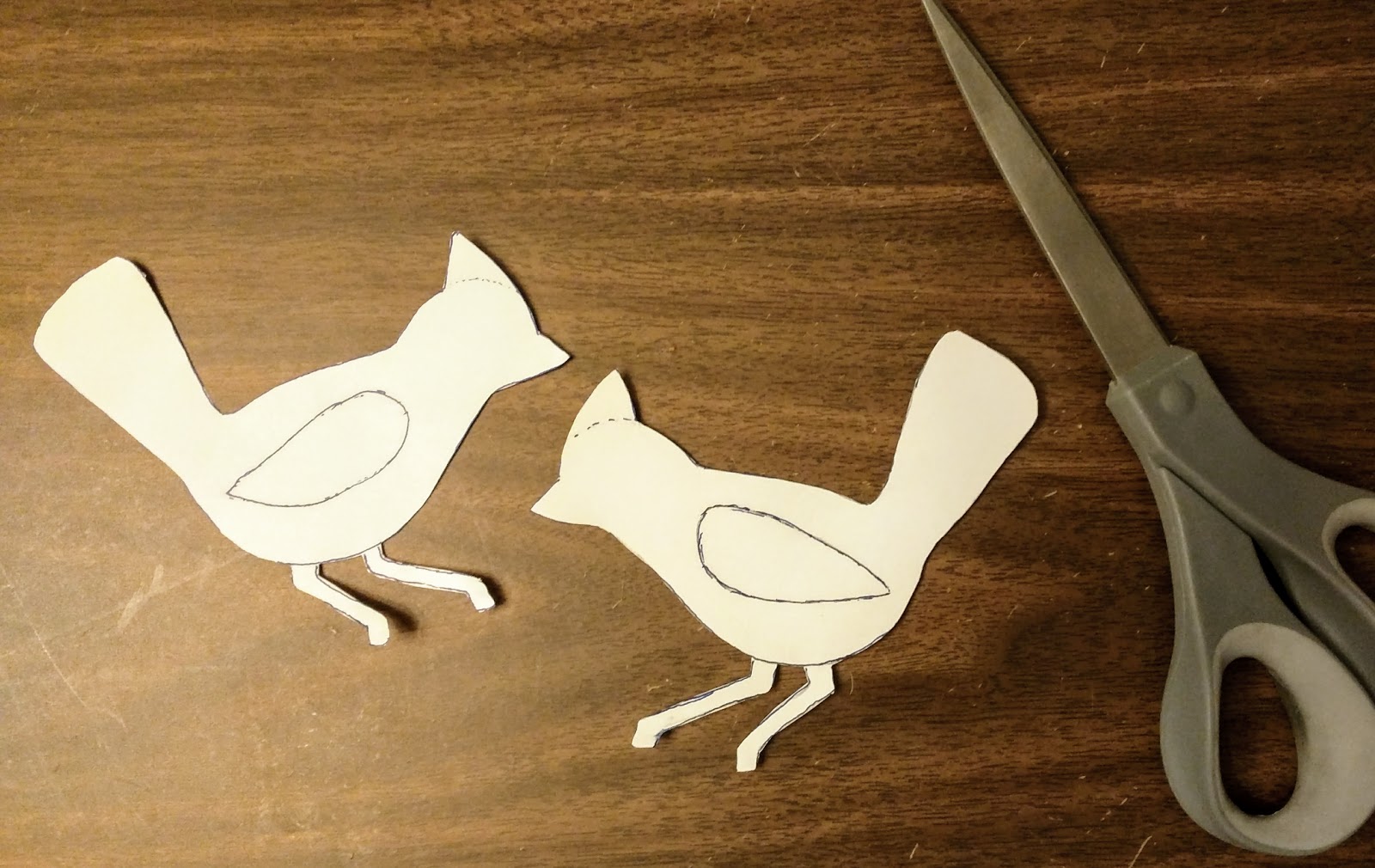
Putting those chubby cardinals on a quick diet was easier than expected. I traced part of my first design but slimmed their heads and tummies. The outline is also an easier curve. If I keep this up I'll be ready for art school soon. 😉 The Slender Cardinal Template PDF is now on my tutorial page.

Slender Cardinal templates

DH and I had a very quiet holiday but managed to travel several times. We finally visited Hearst Castle. My last visit was many years ago. How many? Well, there was only one tour at the time so my mother and I walked all over the place.

This visit turned out like a scene from L.A. Story. Steve Martin's character wanted to go take a trip with his girlfriend but he was the weekend weatherman. He prerecorded his spots because "it's always sunny and seventy in LA." Of course, it stormed all weekend and he was out of a job. We chose the worst day to visit: stormy, blowing, cold {for California.} The hills run straight down to the Pacific from the house but we couldn't see it. We couldn't even see ten feet in front of us so touring the gardens and grounds was out of the question. Nevertheless, the rooms are stunning and we enjoyed our visit.

Hearst hired architect and civil engineer, Julia Morgan, to build La Cuesta Encantada with reinforced concrete to withstand an 8.2 earthquake.  I was particularly taken with the ceilings. Some were from Spanish monasteries and European castles. Shipping them amazed me and then Julia installed the ceilings in new rooms designed to their dimensions. Other ceilings were contemporary plasterwork.

Antique painted wood and contemporary plaster ceilings at Hearst Castle.
Ceilings at Hearst Castle

Hearst and Morgan also installed contemporary and antique tiles throughout the house and grounds. I loved the rooster and donkey window screens in a tower bedroom.

The lower right tile is in the kitchen and contains a Latin motto... with a typo. It either reads "Sine ipso factiv est nihil" meaning "without him nothing was productive" or "sine ipso facto est nihil" meaning "without him nothing was done." Which do you prefer?

Hearst Castle tiles and window screen, 

The lamp with statuette was in one of the guest houses while the lampshades were in Hearst's personal suite. They were made of old vellum in such poor condition they weren't able to be rebound into a book. The top one is a record of indentured servitude while the bottom is a musical score. Can you say cutter quilt?

Desk lamp with statuette and two lampshades of antique vellum

Enjoy the day, Ann

Sunday, January 1, 2017

It's All About the Cardinals and KofB #12

Happy New Year! Wishing everyone good health, good friends, and safety in 2017.

QS informed me this quilt needs cardinals - the favorite birds of our sister and grandmother. I'm not sure how they will fit in but know I need them on hand before sewing the vine. Since my drawing skills are lacking {or at least my confidence in those skills is lacking} I combed the web for easy bird outlines. The final two choices were:
  1. Beth Donaldson posted a number of free quilt blocks from old newspapers, including the Cedar Waxwing and Hermit Thrush.
  2. There are too many "bird on a wire" silhouettes to list. Best thing? Very few have legs... and they look good. That should make it easier.
  3. EDIT: How could I forget Barb's bird when it's part of her blog header? Love the way she added part of the wing in silhouette.
It took the whole evening to draft simple cardinals. I planned to cut the crest off some for other birds or perhaps draft hummingbirds.

Cardinal Silhouette templates ready to use

My t-shirt quilt friend sent the beautiful flowers for Christmas. The bouquet contains lilies, carnations, and roses with special additions of pine and bright red berries. The berries are "the berries." Perfect. What a kind gesture.

Looking at the quilt top again, my cardinals are too fat. Those toile birds are sleek and streamlined. Back to the drawing board.

In case I change my mind, I placed a pdf of the cardinal template  on the Tutorial page downloading. Let me know if there are problems. This is my first attempt at pdfs in Blogger.

Streamlined toile bird silhouettes

At 6.75" this border is more narrow than I hoped. I'm not sure how to curve the vine and also avoid tiny leaves on the outer curve. {Like most beginners} my eye is caught by the most elaborate applique. Quite beyond my expertise.

Possible vine ideas were distilled to simpler, diffuse ones that might better fit the style of my quilt.
  1. The border on Stamp of Approval by Tonya Alexander. Easy curved vine, nice big leaves, yoyo berries. Now I wonder if the leaves are too fat. They match my chubby cardinals but everything may need to go on a diet.
  2.  Is there a way I can incorporate Susan McCord's string pieced leaves? Their longer, skinnier style matches trim birds.
  3. Quilted with Grace posted her first hand applique. I love the multicolored leaves and the groups of berries on this vine.
  4. Of course, Aunt Millie's Garden by Piece o'Cake has two beautiful vine borders. The first is too wide for my border but the narrower is a charming way to make leaf-like flowers.
  5. Jan Hutchison made a quilt from Applique Affair by Edyta Sitar. Jan's second photo shows a section with only a few leaves, a bud, some berries and a bird. Hmm. All the elements I want.
After rereading parts of Collaborative Quilting by Freddy Moran and Gwen Marston, I cut my vine fabric 1.5" before folding. The final width ranges from one-half to five-eighths inches.

I pinned it in a very curvy fashion. Too curvy for the relatively narrow border so it will be changed next week. I think diffuse leaves all the same size will be a good first vine.

This vine is too curvy for the border width.

How do spiderwebs fit with butterflies? I designed the triangles of the webs with my kaleidoscope ruler. Weak, but there it is.

Want something a bit more butterfly-y? Janie at Crazy Victoriana pointed me to Missouri Star Quilt Company's latest YouTube video, Easy Strip Butterflies. It looks like a great way to use some remnants. I see a baby quilt in the near future.

Enjoy the day, Ann

InLinkz removed because it was hacked.