Showing posts with label applique. Show all posts

Tuesday, July 9, 2024

Jane Sassaman Workshop Projects Finished

I would feel more optimistic about a bright future for man if he would spend less time proving he can outwit Nature and more time tasting her sweetness and respecting her seniority.
~E.B. White

Quilting


Jane Sassaman is a fabulous teacher. While I would have preferred to take a week of classes from her, even one day was great. She shared details of every step to complete a quilt in her style from design to construction to quilting. This was the sample I made in class. As Jane told all of us, enjoy the process; this is not an award-winning quilt. That freed me up to absorb as much of her technique as possible. 


Quilt Specifics
Size: 18" x 30"
Design: Mirror Image Applique, Jane Sassaman workshop
Batting: Mountain Mist Cotton
Thread: Superior cotton 12-wt and topstitching threads in various colors
Quilting: Walking foot
Approximate yardage: about 3 yds

When I returned home, there were so many leftovers - each already prepped with interfacing - that I decided to make something to use them up.  The peach background was the one fabric I too to class but didn't cut. That became the background by default. I gave the bright yellow to classmates; it turned out to be a good color to add pop. And I lost most of the light green. I guess I dropped it on the way out. 

There were some big chunks of purple and black but the greens were already long, narrow cuts. 


Quilt Specifics
Size: 18" x 18"
Design: Applique, original design
Batting: Mountain Mist Cotton
Thread: Superior cotton 12-wt and topstitching threads in various colors
Quilting: Walking foot
Approximate yardage: about 2 yds

My zinnias are flowering profusely and the butterflies are frequent visitors. A giant swallowtail comes by for every meal currently.  

Enjoy the day, Ann

Tuesday, June 11, 2024

Workshop Leftovers

I think of each life as a flower, as common as a field daisy, and as singular.
~Mary Oliver


Quilting


There were so  many leftover pieces from Jane Sassaman's workshop that I simply had to make a second top. This time I decided to sketch an idea that wouldn't be symmetrical. There was only one prepared fat quarter uncut so that was my background by default. The colors are off in the photos but it's peach.

I pulled all my leftovers out and looked them over. There weren't many mirror-images left but there were some large blobs. I decided to create a bouquet a coneflowers. Since there wasn't enough to make cutting mistakes, I first drew the main pieces on construction paper, cut them out, and played. Once they fit the space, it was time to cut from fabric. About half the paper has been replaced in the photo below.


One mirror image was cut in two, thinking it would make stem and leaf combination. The "leaves" just got in the way. Adding them separately worked better. 
 

There still seem to be just as much fabric leftover but no more background fabrics. Perhaps I'll make a third top some time. 

Reading

Emma Southon focuses on 21 "women of the Roman empire" and revises history by focusing on ordinary lives of people mostly considered unimportant by their society. She begins in 750 BCE with Tarpeia, who convinced her Sabine relatives not to slaughter the kidnapping Romans. Because, you know, blood is thicker than water and they were now all relatives through the newest offspring. 

Her stories continue through Galla Placidia in 414 CE, the daughter, wife {twice}, and mother of Roman emperors as well as the wife of Ataulf of the Visigoths and eventually a co-Augustus.

My favorite may have been Julia Felix, a successful businesswoman who left written records on the walls of Pompeii. 

The British title is The History of the Roman Empire in 21 Women.

Enjoy the day, Ann

Tuesday, February 16, 2021

Circling the Shadow Star Quilt

(Fascism develops) not just through the terror of police intimidation, but by denying and distorting information, by undermining systems of justice, by paralyzing the education system, and by spreading in a myriad subtle ways nostalgia for a world where order reigned.
~Primo Levi

Quilting


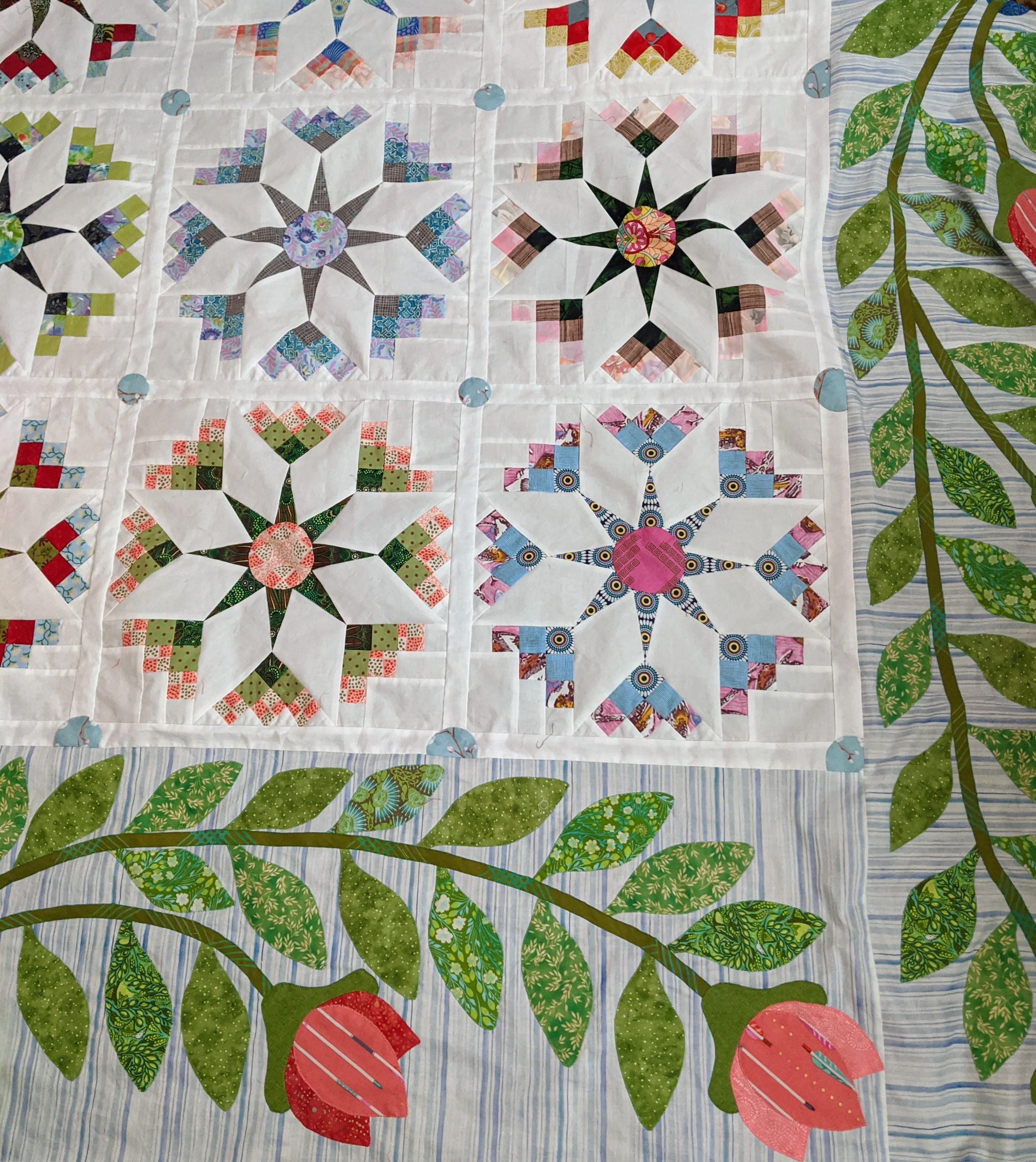
The border of Shadow Stars caused me lots of trouble. My great-aunt's quilt didn't have any border but adding one would update the design. Over the years I've seen many beautiful borders. For example, this gorgeous Weeping Willow tree border from an antique quilt in the American Folk Art Museum has long been one I'd like to interpret. My skill set is not up for those but pieced Pine Trees seemed like a good idea until I realized that putting them on point left too much open space {and I couldn't figure out a way to fill it that didn't overpower the rest of the quilt.} So those blocks and the Shadow Stars rested for a while; the tree blocks are still resting.

Eventually appliqué became the solution. There's an appliqué vine on the Spiderwebs but I didn't want to repeat the sinusoidal wave of that vine. Nor did I want raw edge appliqué. The Stars called for turned edge. Linda Jenkins and Becky Goldsmith made a straight vine on one of their quilts. Love the shading of the background here. But it seemed too contemporary with my white stars. 

When a family friend now in college took flower arranging for her art elective, she shared some of her work at Zoom dinners. Now I know what Hogarth curves are. Those S-shaped designs wouldn't fit in this space but they got me thinking about the many Baltimore album quilts with beautifully elaborate vases.  It took many iterations to simplify one of those into this border. There wasn't room for lots of flower height above the vase and the vase itself is so basic. No reverse applique, no curlicues. OTOH, fussy cutting a large print elevates the vase.

Once the borders were attached, there was too much contrast between them and the center. Who'd have thought pale blue, green, and white could create such a stark difference. The green is stronger so adding some light blue to the center might be the answer. 

Blending border and center by adding small blue circles
Shadow Stars with small circles only

The first circle attempts were small but slightly larger than the center post but the border delineation still seems too sharp. Adding only half circles along the border creates a bit of fuzziness but the center is stark.

Blending border and center by adding blue half-circles
Shadow Stars with border half circles only

It's more work but the quilt needs these dots/circles/spots of color in both places - at the posts and along the border. But now the circles seem vanishingly small. Too innocuous?

Blending border and center by adding blue circles and half-circles
Shadow Stars with small circles
and border half circles

Just to be safe, I tested larger circles at the posts. They overpower the stars.

Blending border and center with large blue circles and half-circles
Shadow Stars with large circles
and border half circles

I snapped a quick photo when the work was half done to double check. On the left is a complete contingent of circles while on the right the circles are only along the border. FYI, everything is hand appliquéd but the border circles are only sewn halfway. When they are all attached, I'll go back and resew the border so the other half of those circles will disappear. Simply appliquéing them all around won't work; some of the leaves are in the way.

Shadow Stars circles in progress

This was perfect work for the evening hours. It took a few days to finish, then I rechecked all the seams looking for twisting. 

Shadow Star quilt top ready to quilt

Now it's off to my longarm quilter. I decided not quilt anything this large again. Smaller work is better for me these days. {We'll see how long that resolution lasts.} I'm looking forward to this as a summer quilt on the bed. 

Reading


Madeleine Albright, former US Secretary of State, wrote Fascism: A Warning in 2018 but it's even more pertinent now. She starts with the beginnings of fascism in Mussolini's Italy and moves to Hitler. Subsequent chapters discuss more current world leaders.

She defines fascism as "majority rule without any minority rights... that involves the endorsement and use of violence to achieve political goals and stay in power. It's a bully with an army."

Her solutions are to get involved locally and talk with people with whom you disagree. Good starts. We also need to ground discussions in reality rather than conspiracy. 
Enjoy the day, Ann

Tuesday, January 19, 2021

Never Ending Leaves and a Few Bud Bases

It is possible to read the history of this country as one long struggle to extend the liberties established in our Constitution to everyone in America.
~Molly Ivins

The US turns to healing our bodies and souls with the inauguration of President Joe Biden and Vice-President Kamala Harris tomorrow. I will be but early to watch. Let's commit to more than watching though. Let's become involved, especially in local matters and primaries, so horrors like these last few years don't happen again.

Both the 2016 and 2020 elections showed that the majority of Americans did not support the policies of the group that came to power in 2016. By neglecting to participate early, by waiting to see who and what "the parties" promoted, we lost the opportunity to shape those policies. A small group of dedicated, single-issue radicals swung our national agenda shamefully and cost us hundreds of thousands of lives.

Adults know we have to do things we don't want. Sometimes it's working every day, putting on a smile when we would rather go back to bed. Creating equitable political structures is another duty of adulthood - if for no other reason than to keep sadistic, misogynistic, and racist opinions out of the laws of our land.

Quilting


I cut out all the leaves starting with the smallest fabric remnants to maximize diversity. They were then sorted into four piles like dealing cards so each border has basically the same ratio of each fabric. Here is my set for the second side. Oh, my fingers hurt from all this sewing. Even with a thimble.

A stack of hand basted leaves with pincushion and thread spool
Basted leaves for a quilt border

Of course, the first two sides are shorter than the last two so I started sewing them first. Then the leftover leaves were set aside for the longer sides. It's not a perfect system but maintains some semblance of diversity.  

Again the leaves are blanket-stitched so their stems nestle under the vine. I shortened both the stitch length and the zigzag. My Bernina also has a mirror image function that lets me align the "teeth" of the blanket stitch to either side. That makes sewing easier, too. 

Bernina 1240 set to applique leaves with a blanket stitch
Blanket stitch by machine

Once the leaves are sewn, I re-pin the vines and sew them down. Then it's time to add the flower bases. This template has had the most changes. At first I planned a double-lobed leaf on each side, kind of like a dumbbell. It was too difficult to machine quilt and I ended by including the base with the leaves. Actually it now just looks like a larger base. Whatever. It works. 
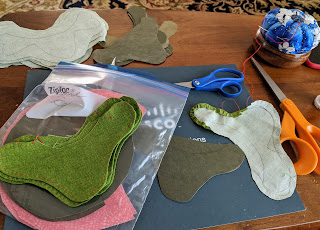
A stack of hand basted flower bases with scissors and pincushion
Basted flower bases for an applique quilt border

In the plastic bag the bright pink flowers are cut and ready to be basted next. It's taking about three days to get all the parts basted and another day to pin just the leaves. Then sewing, repinning, more basting. Not a lot to show at the end of the week but I'm sticking with it. It's time to get this top done. I only hope it looks as good as my sketches. 

Lectures

One of the unexpected joys of the pandemic is the upwelling of internet meetings that allow international speakers and audience to interact. And one of the benefits of multiple program chairs is the diversity of vision they provide. Sue Bianchi, one of our program chairs, arranged a unique speaker for our December guild meeting - Harriet Riddell of the UK spoke on Street Stitching Around the World. Artists must be brave to put their work out for public response but Harriet takes it to another level. She takes her electric sewing machine around the world to stitch the scenes in front of her. The audience in the street power her machine by pedaling a bike. Sounds crazy, yes? What a opportunity to interact with people, build connections, and build a portfolio of ever-increasingly skilled work.

Last week I joined the first lecture of The Black Index: Artists in Conversation sponsored by the Getty Institute. The online exhibition curated by Bridget Cooks and this month's lecture included two conversations. Professor Leigh Raiford interviewed Lava Thomas about her pencil sketches of the Montgomery bus boycott mug shots. The history Lava researched for this series reminded me of Patricia Montgomery's swing coats

After a short break, curator LeRonn Brooks and Whitfield Lovell discussed his drawings of card players. Photos of family and friends playing cards highlighted how the cards are the intersection between the viewer and the subject. Whitfield took time to choose the correct card for each person. In a way, this reminded me of Susan Shie's Tarot Cards althought she did it the other way around, chosing a card and then created images for it. Susan embellishes her work with extensive writing across the surface. 

Interestingly both textile artists wrote on their work while the others did not. Another feature that struck me was the use of well-known people as models versus "the man in the street." It recalled artists who were paid for commemorating prominent people versus Impressionists who sold work using unknown models or family. The various reasons give us food for thought.

Replays of this lecture are available at the Getty and more are planned monthly.

Enjoy the day, Ann

Tuesday, November 24, 2020

Figuring Out the Best Appliqué Prep

Do what you feel in your heart to be right for you'll be criticized anyway.

~Eleanor Roosevelt

Quilting


Whenever I appliqué it seems to need different methods. There are two older but excellent machine appliqué books in my personal library: Mastering Machine Appliqué by Harriet Hargrave and Traditional Quilts Today's Techniques by Debra Wagner. 

Two books on a green cutting board
Machine appliqué instruction books

I drafted my patterns on graph paper then looked for something to reinforce it. The plastic on hand is either too thin or too small. But... there's a whole bunch of file folders from my shredding summer. Woo hoo. Doubled up with some glue, these are quite strong and the supply is almost limitless. So I can trace lots of leaves without compromising the edges of the design. 

Next issue is appliqué. What to do?
  • I actually have {needle turn} appliquéd an entire bed-size quilt {top} but that was years ago. 
  • When appliqué was required for some early t-shirt quilts, the backs are stabilized with fusible interfacing and then they are stitched with a narrow zigzag. Quick and easy. The knit fabrics limit fraying unlike wovens. 
  • Quilty365 circles started as needle turn but quickly changed to the "gathering around a template method." 
I chose needle turn but quickly realized that wasn't great for machine work. And there's no way I'd get this finished if handwork is involved. 

I tried gathering around the template which doesn't work well unless it's a circle. 

hand basting gathers the seam of an applique leaf around the cardboard template
Gathering the seam around a template 

Next I glued the turned edges to the template which worked okay until trying to remove them. Result: A quick way to ruin paper or cardboard templates.

Applique seam is glue-basted to the template
Glue basted applique

Now I'm simply turning the seams under and basting in contrasting thread to help me identify the correct one when it's time for removal.

Applique seam is turned and hand basted with red thread for easy identification
Thread basted applique

Three down; 197 more leaves to go. 

Monthly FUR (Fabric Use Rate) 

No quilts completed in November. Not that I'm sad since I'm working on this massive project again.  
YTD = 159.5 yards.

Reading

Most evenings this month I've been reading Underland: A Deep Time Journey by British nature writer Robert Macfarlane and it's finally finished. Caves, mines, tunnels, and crevasses reveal geologic time, prehistoric art, funeral practices, and nuclear waste storage for millenia into the future. Robert spans the globe taking us to different sites and showing what they hide. At times claustrophobic but definitely mind-expanding. NPR has an excellent review here.

Happy Thanksgiving! Wherever you are, I hope you and your family are well and staying safe. We're all looking forward to better holidays in future when we've gotten ahead of this terrible disease.

Enjoy the day, Ann

Tuesday, November 17, 2020

Cutting Leaves for the Shadow Stars Border

What is the use of living, if it be not to strive for noble causes and to make this muddled world a better place for those who will live in it after we are gone? I avow my faith that we are marching towards better days. Humanity will not be cast down. We are going on swinging bravely forward along the grand high road and already behind the distant mountains is the promise of the sun.
~Winston Churchill

Quilting


With so many colors in the Shadow Stars already, more green vines and fewer flowers seems like a better idea. I drafted several versions of the vines, made many minor changes, and then cut some simple leaf templates.

Paper leaf templates

Now it's time to review the greens. The stack that looked so good on the border stripe is now set on the Shadow Stars and it's easy to see that some are too bright. The Stars are a cheerful collections of clear and toned prints that {possibly} evoke a bit of Depression-era nostalgia. But none of them are reproduction fabrics. While I like nodding to a bygone time, I don't want a reproduction quilt. Neither do I want the border prints to overpower the Stars. 

So the two more colorful prints on the left are discarded along with the bright green on top. I may not keep the two polka dots underneath either. The remaining fabrics are quieter and more monochromatic. We'll see if there's enough to complete all the leaves. Merely 200.

Several green prints are laid on the Shadow Stars that will form the center of the quilt
Green prints for leaves

Leaf templates on regular paper won't last long so they are reinforced with the heavy cardboard from the old hanging folders. Boy, I'm glad I didn't dump these yet. Each can be reused several times before the edges become soft and I can lay them out to maximize use of my fabrics.

Cardboard backed paper templates are laid on fabric for marking
Arranging leaf templates on fabric

Reading

Martin Walker spent his career as a reporter for The Guardian and UPI. He also wrote several non-fiction books about European, Russian, and American politics including The National Front, Waking Giant, and Clinton. After moving to France, he began the Bruno mystery series centered on a local policeman. 

I finally read the first one, Bruno, Chief of Police, and enjoyed the way Martin incorporates his previous work into a believable and unique story. Tony Hillerman wrote a fabulous mystery series that introduced his readers to the Navaho homelands and Martin's books develop from a similar love of the Périgord region. He weaves threads from French history with current events about wine-making and small town life to create a memorable story. I'm looking for the second one now.

Enjoy the day, Ann

Tuesday, November 10, 2020

Fiddling with Flowers on the Shadow Stars

The cure for the ills of democracy is more democracy.
~Jane Addams

The US election results are in with joy for many of us but also sorrow that the vote was anywhere close. Much work remains to help minority communities, to reestablish science and belief in its research, and to rebuild faith with our democratic partners internationally. Hopefully we can all commit to considering the words we use and the meanings and intentions behind every word and policy.

Quilting


My head aches from all the ideas running around it. First, I thought I could sew the four main pieces of the flower together and appliqué the finished group as as single unit. You can see that wasn't such a clever idea. The three petals went together easily but then form a thick seam allowance against the green base. Lumpy and pleated result. This is NOT easier. 

Not only that but the double petal on the leaves is too difficult for me to machine appliqué. Something else to simplify. 

The flower seams are pleated as it rests in place atop the vase
Partially seamed flower

On to Plan B. Or is it C, D, or E? I forget. Each piece of the flower unit will be appliquéd separately. And I redrafted the base into more abstract shape. Much easier. 

Next it's time to remove the center of the vase rim so the stems will fit inside. I made a template with the center oval cut out and laid it over the rim. Then I marked the inner oval with chalk and carefully, with much trepidation, cut the vase fabric in the middle so it could be reverse appliquéd. 

Trimming for reverse applique

The back of the rim must be appliquéd before the stems will fit into the vase.  Finishing the front of the vase comes later. This is fussy but not too difficult. I just need to be careful when I restart the stitching. Ha ha ha. 

I adjusted the amount the rim is turned under until it looked even then blanket stitched from one inner curve to the other. Meanwhile the rim's front seam allowance was pinned down to retard fraying. Then each stem was inserted and blanket stitched just to the edge of the rim because leaves still need to be inserted under the long stems. Finally the front of the rim could be appliquéd. Not too bad.

Applique vase

And because I still wasn't sure how the flower would look, it was appliquéd in place, too. Four thread changes. This is not simple but still much easier for me than hand sewing. We already know it takes thirty years for me to complete a quilt by hand

Reading

The Return of the Thief, the sixth and final novel in the Thief series by Megan Whalen Turner was published last month and I just finished reading it. Twice through. The books are set in an alternate world reminiscent of ancient or medieval Greece. The tiny countries of Sounis, Eddis, and Attolia occupy the Little Peninsula with larger empires and confederations on each side hoping to annex them. 

Pheris narrates this book. He appeared at the end of the previous one as the "youngest attendant" of the king. Here we find he is the disabled heir of Baron Erondites, the leader of the faction trying to depose the king. When the baron is forced to send his heir to be raised {and influenced} by the king, he sends Pheris, planning to kill the child later and name a new heir. 

If you've followed the series, you know the Medes are preparing to invade. The Little Peninsula must find a way to truly unite against them. There isn't much more I can write without spoiling the plot. And since it's the final book, reading them in order would really help.  

The series started over twenty years ago but remains one of my favorites and this final novel makes a fitting conclusion. 

Enjoy the day, Ann


Tuesday, December 17, 2019

Adding Flowers to Tethys Waves

"The danger is not that America will collapse into a Depression tomorrow... The danger is that the paralysis of the American political system - its inability to tackle any big multigenerational problem anymore - will just very slowly erode our strengths and assets as a society. We will slowly choke off immigration, slowly give up our commitment to free trade, slowly allow the budgets for research in science to decline, slowly let our public schools slide into mediocrity, and only slowly face up to our energy challenge."
Thomas L. Friedman
Hot, Flat, and Crowded, p20, 2008


Friends are a blessing. The blue striped yardage from Kaja that was used to bind the Froggy Star reminded me of Tethys Waves because it's in the same family of blues. There's enough to appliqué triangles over those gaping white triangles on the sides. But then... Thinking about the AHIQ flower challenge, a better solution presented itself. You guessed it. Flowers. A small bit of red batik scrunched under some larger pieces lurked in my stash. Ah, the joys of cleaning house... Well, at least of cleaning the sewing room.

Red batik flower petals with striped blue centers.
Half flower pinned on the sides

Can you tell I don't appliqué much? That's a lot of pins. But this time I wanted to see the result before sewing everything. See, this old dog can learn a new trick. After pinning three red petals and adding a blue center to one I can tell the idea works. It tones down the gaping white triangles while blending with the floral theme of the red squares.

The cream corners are filled with half flowers of red batik and blue centers.
Half flowers added to Ocean Waves

It's only eight half flowers. How long could it take? Knowing myself, much too long if handwork was involved. So these were blanket stitched by machine in matching thread. Done it a couple of hours.

Red and white print creates centers for an Ocean Waves quilt. The side triangles are filled with red batik half flowers with navy blue striped centers.
Tethys Waves quilt top with side flowers

Now to find a back. And consider whether or not to add a border. And figure out a quilting design that won't take the rest of my life.

Off the Bookshelf

The cover shows a blond woman in a ruby red Regency gown  looking over her shoulder. Fairy lights of glamour light up the background. I enjoyed the Lady Astronaut series so much I picked up Shades of Milk and Honey, too. It's the first of an older series by Mary Robinette Kowal set in Regency England with a small twist - magic exists. Threads of glamour can be pulled and twisted to created visible images. Young ladies of quality are expected to practice this talent along with painting and music.

Mary credits Jane Austen as her inspiration. While not as complex and deft as Jane's novels, it is an intriguing read that reminded me of Rick Riordan's first book, The Lightning Thief - another clever first book developing a coherent alternate world - that should improve throughout the series. Definitely worth the time.


Enjoy the day, Ann

Tuesday, May 14, 2019

Chinese Coins in Yellow Baby Quilt

As I wrote recently, I haven't felt very creative lately; I still don't. Sewing is relaxing but making all the decisions for a new quilt overwhelms me. Working on leftovers, extras, and older projects fits my abilities for now. Plus, they are {finally} moving along. {Go, team, go. On the floor and out the door.}

Case in point: If you recall Chinese Coins XII, made for my co-grandmother, started with columns from a Coin that didn't work. Adding sashing makes a few Coins go a long way so there are still loads of these columns left. As you would expect, I cut several extra WOF solids strips, too. How easy to sew them into another baby quilt.

At the end of last year I had five baby quilts; now they are all gifted. Nothing in the queue and DH's co-workers are still having babies!

This time I pulled the yellows and ochers. The yellow and white stripe sets them off well, especially after  the strong inner border was added. It looks as if these fabric purchases were planned but that is not the case. Buying fabric at one time for a quilt usually is a recipe for disaster for me.

As Audrey wrote recently, it's much better to pull from different years and brands. Making things work that aren't dyed to match gives me so much pleasure. After all, when all the decisions are made, there's nothing else to do but sew them up. That may be why we have so many UFOs. All the creative parts are done and we're left with the chores of sewing, pressing, and trimming.

scrap quilt with yellow and ocher sashing
Chinese Coins in Yellows (CCXIII) baby quilt

However, compared to Chinese Coins XII, this top seems unfinished. It lacks the snappiness the rows of tulips gave the previous quilt. What to do?

The spirals in the border gave me the idea to add spirals in the center. They are black so it was my original choice but when the fabric was laid on the quilt, anyone can see it's too severe. Back to the stash where I pulled this marsala shade of shot cotton. Much improved.

Possible applique fabrics for
Chinese Coins in Yellow (CCXIII) baby quilt

With only a ten-inch WOF, I cut it on the diagonal and made two bias strips to put through bias tape makers of 9- and 12-mm. Pinned on the top, they are much too small and insignificant.


It either needs a larger spiral or many more small spirals. I've never had much luck sewing strips together and putting them through the bias tape maker. They always pooch out where the seams join. Shot cotton is very thin so I decided to try it again but didn't have confidence it would work. Wrong-o. No trouble at all.

One larger spiral of 12-mm bias tape pinned on the quilt scales better.


"This is just a baby quilt," I kept repeating but the tiny spirals looked too ... tiny. Eventually I replaced the narrowest one with new, large 12-mm spiral. Then I left it on the wall for a couple of days.


scrap quilt with yellow and ocher sashing and marsala spirals
Chinese Coins in Yellows
with Spirals (CCXIII) baby quilt

I like the mixed spiral sizes {and I liked not having to replace the third} so I sewed each side of the spirals down. The inner end is tucked under the spiral; that wasn't difficult. The outer end had to be turned; that took a while. Obviously I need more practice.

detail of Chinese Coins in Yellows
with Spirals (CCXIII) baby quilt

The thread ends need to be pulled to the back and tied. And look. Those aren't spirals in the border; they're concentric circles. Someone needs new glasses.

Enjoy the day, Ann

Tuesday, January 29, 2019

Medallion Chinese Coins III Quilt Finished

"When I say it's you I like, I'm talking about that... deep part of you that allows you to stand for those things without which humankind cannot survive. Love that conquers hate, peace that rises triumphant over war, and justice that proves more powerful than greed."
~ Fred Rogers ~

While {I'd like to say} quilt designs are rarely reprised or repeated, I've recently completed a second pair of baby/toddler quilts. This pair is even more identical than the previous ones except the sizes vary this time. That makes them a perfect older sibling/new baby gift. Not that there's one on the horizon, but it will come.

Chinese Coins III Medallion quilt with appliqué

Adding appliquéd flowers made these tops into something more special. Remember they were the bottom of the scrap bag. It took both quilts to actually empty the bag that time. The technique is a variation of raw edge appliqué. Check Lara Buccella's book Crafted Appliqué for more information.

Chinese Coins III Medallion quilt
appliqué detail

To make it more like the other medallion, I quilted Baptist Fans again. Free motion quilting is a good change of pace from all the simple walking foot lines I've been doing. And so relaxing.

Chinese Coins III Medallion quilt
Baptist fans FMQ detail

When it was time to bind the quilt I found a pile of orange leftovers in the scrap bag and trimmed them to size. Unfortunately they don't look good on this quilt. They are simply too bright. So...

Chinese Coins III Medallion quilt
with possible bright orange binding

I found a lighter peach remnant in my stash. This shade isn't as bright plus the white design printed on top brings the intensity down further.

Chinese Coins III Medallion quilt
with light peach binding

Here's a view of the back showing the Fans and the quiet binding.

Partial view of back of
Chinese Coins III Medallion quilt

And here's a view of the binding itself with the outer border and parts of the back showing. Yes. This works much better.

Chinese Coins III Medallion quilt binding detail

This pair will go on the stack until two children need them.

Size: 50" x 58"
Pattern: Medallion with Chinese Coin borders and appliqué
Batting: Mountain Mist Cream Rose 100% cotton
Thread: Aurifil 50-wt grey cotton 
Quilting: free motion Baptist fans

Previous posts:
  1. Starting the medallion
  2. Chinese Coins III top finished
  3. Chinese Coins IV finished
Enjoy the day, Ann

Tuesday, August 21, 2018

Using Little Bits of Time

This time I'm hand turning the applique leaves before attaching them. I haven't used this technique in years but it's going faster than I recalled.  As they are turned, more "space" opened up so I cut more leaves until the fabric ran out. This is it. Must work it out somehow.

Adding leaves to
Chinese Coins VIII: Strewing Roses

The photos were shot after dark making the fabrics darker than reality. But I like the way the leaves are backlit and/or they fill in the lightest area of the quilt.

Recovering my full energy has taken a long time. I'm not there yet but am better every day. In the meanwhile, I was inspired by Cathy's post last month detailing 20 minute work segments. While I can't work on as many projects as she does {How do you keep them all straight, Cathy?} this seemed a good way to push some older projects forward. As I learned from my Thirty-Year Sampler, consistent work is the only way to complete it. And besides, 20 minutes is about all the strength I have these days.

The Bars 4 quilt needs to be finished for a future gift. Again I'm using very simple straight lines with the  walking foot. Twenty minutes uses part of a spool and keeps it moving along.

Machine quilting Bars 4

After a nap I switch to these old paper-pieced sawtooth borders planned for the New York Beauty. The papers were drafted and strips were cut. It's been languishing under my sewing table for a couple three years and the blocks are even older than that. How time flies and styles change. I'd like to finish it before I'm completely disenchanted. BTW, I chose an alternate (and older) name for this quilt: Rocky Mountain Road.

Paper-pieced sawtooth borders
for Rocky Mountain Road

Several triangles can be added before I have to change the bobbin. And then it's time for another nap.

Enjoy the day, Ann

Saturday, September 23, 2017

Applique Numbers

Although they make me laugh, these ballplayers are missing something. There's too much empty space on their uniforms. And in the yard. I haven't figured out what to do about the grass but..

Phillies ballplayers in unnumbered jerseys

I bothered FO {that's Future Owner} for a list of his favorite players and their numbers. With a serious drop dead date and threat to add Giants players to the quilt. Ha. I'd feel guilty but it worked. He sent the list, I graphed the numbers and appliqued them to the chests. I thought they were perfectly straight but these two are slightly aslant. Whoops. It adds to the folk-art charm, right?

Player numbers appliqued on jerseys of Phillies baseball quilt.
Adding numbers to the Phillies ballplayer jerseys
All that's left is slow, careful cutting. I'm out of the pinstripe so can't make a mistake here. Sure wish I'd numbered the jerseys before sewing the uniforms. It would have been much easier.

This coming Tuesday is AHIQ linkup. Are you ready to share your words? I am! And I can't wait to see what everyone else has done.

Enjoy the day, Ann

Tuesday, January 17, 2017

Vine Border Complete

It feels like the applique took an inordinately long time but that's not true. Improv machine piecing takes just as much time.

The border came out well. The cardinals look like birds... well, like folk art birds. The leaf fabrics worked well. I like the unrealistic, but mostly quiet colors. It's darker than the toile and quieter than the spiderwebs - exactly to plan.

Cardinals sit on a leafy vine border around two sides of this scrap spiderweb quilt.
Spiderweb quilt top with vine border

I'm considering another border. Partly because I prefer bed size quilts but also because it looks unfinished. Hmm.

Next week begins the AHIQ Improvisational Challenge. Each quarter we will introduce a quilt or technique that can be adapted as improvisationally as you choose. We hope you'll join us in our exploration of utility and improv quilting.


Enjoy the day, Ann